

Getting calls from a weird number is annoying at best—and stressful at worst. A good phone number lookup service helps you answer the basics: Is this spam? A real business? Someone I actually know?
But here’s the reality: reverse phone lookups aren’t magic. Many numbers are prepaid, VoIP, newly registered, or hidden behind privacy rules—so no service can guarantee a full name + address every time.
This guide shows what actually works, how to pick the right option (free vs paid), and how to stay on the right side of the law.
Short on time? Quick verdict
- Best “start here” option: Scannero — Reverse Number Lookup
- Best if you want a fast test before committing: Scannero — Trial
- Best if the situation is “lost phone / family safety”: Scannero — Lost Phone
- Best if you only need “who is this number” quickly: Start free (Google + social search), then use Scannero if needed.
Quick jump: 60-second checklist · Verdict · Comparison table · What really matters · Best for your situation · Setup tips · Review · Legal notes · FAQ
60-second decision checklist
Answer these fast, then pick the right lookup method:
- Goal: Do you want spam verification, caller identity, or family/lost-phone help?
- Country/region: Lookup accuracy depends heavily on local data sources (some countries are simply harder).
- Number type: Mobile, landline, VoIP, or prepaid? Prepaid + VoIP are often the hardest to identify.
- Do you have permission / legal authority? If this crosses into tracking or monitoring, read: Legal phone tracking: what’s allowed and what’s not.
- Need a bigger “monitoring vs lookup” overview? Use: Top 10 Parental Control & Phone Monitoring Apps Comparison Table.
Verdict: best phone number lookup service
If you want one practical tool that covers the common scenarios (reverse number lookup + “search phone number” + lost phone angle), start with Scannero — Reverse Number Lookup.
If you’re not sure it’s worth paying yet, use Scannero — Trial to test the workflow first.
If the situation is urgent (lost phone / family safety), use Scannero — Lost Phone and follow a consent-first approach.
Check Scannero Reverse Number Lookup | Try Scannero (Trial) | Search a Phone Number
Comparison table
The smartest approach is usually: free checks first → then a paid lookup if you still need answers.
| Method | Best for | Pros | Cons |
|---|---|---|---|
| Free search (Google + social) | Quick “is this spam / business?” check | Fast, free, often enough for obvious spam | Doesn’t help with private/prepaid/VoIP numbers |
| Caller ID apps | Real-time labeling (spam/warning) | Useful for screening incoming calls | Not always accurate; depends on shared databases |
| Scannero (paid lookup) | When free checks don’t answer “who is this?” | Purpose-built reverse number lookup workflows | No service can guarantee full identity for every number |
| People-search databases | Deeper identity research (region-dependent) | May provide extra context where available | Coverage varies wildly by country; can be outdated |
What really matters in phone number lookups
1) Accuracy depends on number type
Landlines are often easier than mobile. Prepaid and VoIP numbers are commonly the hardest to identify reliably. That’s why you should treat any “guaranteed results” claim skeptically.
2) “Lookup” is not the same as “tracking”
A lookup tries to identify an unknown caller. Tracking tries to locate or monitor a device/person. If your situation starts drifting into tracking (even for legitimate reasons), read: what’s allowed and what’s not.
3) Use-case clarity saves money
Most people don’t need “everything.” They need one answer: spam or real, safe or risky, known or unknown. If your actual concern is family safety or a lost device, these guides help:
- How to track a phone number with Scannero (tutorial)
- How to monitor a lost or stolen phone
- Best GPS tracker apps for families
- Top ways to find someone’s location by phone number (use responsibly)
4) Privacy and consent are not optional
If you’re using lookups to harass, stalk, or intimidate someone, that can cross legal lines quickly. Keep it consent-first, safety-first.
Best for your situation
Best for identifying unknown callers (spam vs real)
Start with free checks: search the number in Google, check if it appears on business pages, forums, and social profiles. If that doesn’t help, use a dedicated service like Scannero Reverse Number Lookup.
Best for parents (kids receiving suspicious calls)
Your goal is safety, not “spying.” Identify the caller, block if needed, and document patterns. If the bigger problem is risky contacts + device habits, use a broader comparison: Top 10 Parental Control & Phone Monitoring Apps Comparison Table.
Best for lost phone / urgent family situations
If the context is a lost phone or a family emergency, use Scannero Lost Phone and keep everything lawful and permission-based.
Best when you want to “test it first”
Use Scannero Trial to see if the workflow fits your needs before committing.
Setup tips (to improve your chances of useful results)
- Format the number correctly (include country code). Wrong formatting = weak results.
- Do a free search first to catch obvious spam/business numbers.
- Decide your goal: identity check vs safety scenario vs lost phone—then pick the correct workflow/service.
- Don’t over-interpret partial matches: some numbers resolve only to carrier/region/type (mobile/VoIP).
- Stay legal: if your use case crosses into tracking, read the rules first: legal phone tracking.
Reviews
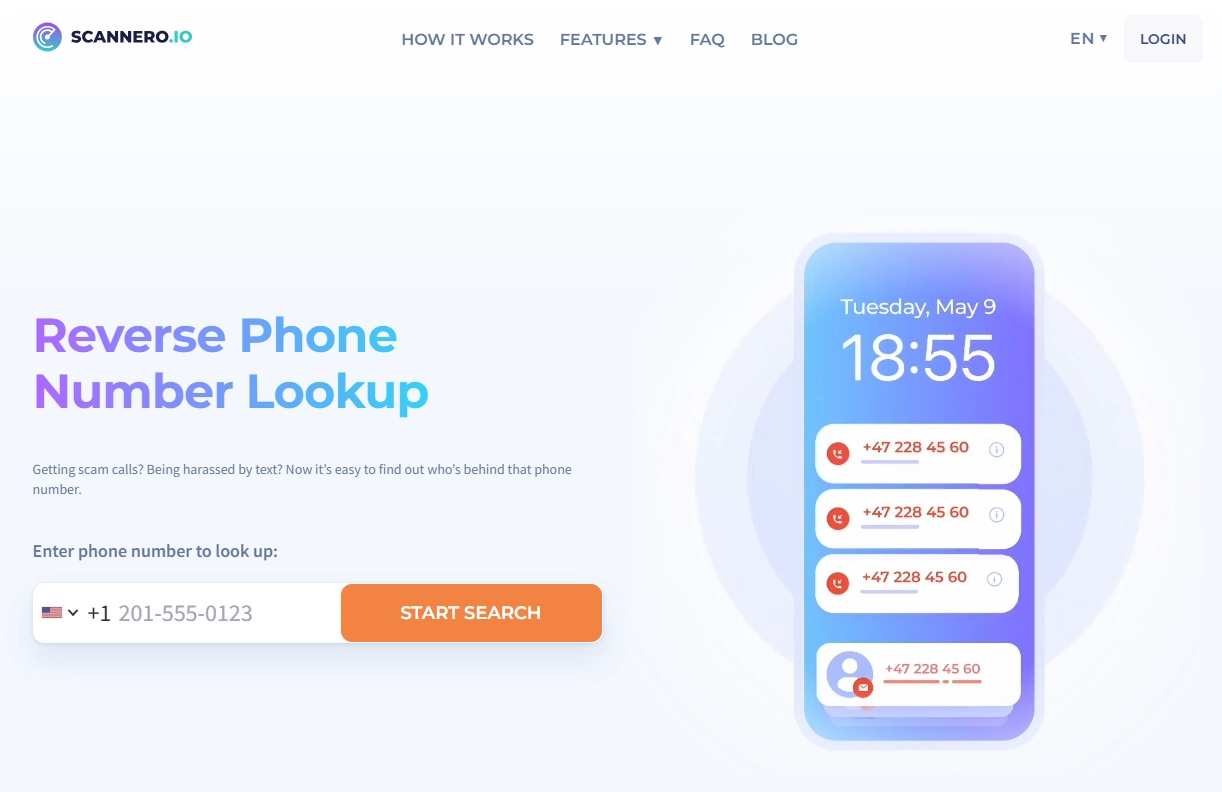
Scannero (Phone Number Lookup Service)
Description
Scannero is a practical phone number lookup toolkit built around common real-life scenarios: reverse number lookup, searching a phone number, and “lost phone” style workflows. It’s best for people who already tried free searches and still need clearer answers.
Product highlights
- Dedicated reverse number lookup workflow: Reverse Number Lookup
- Quick “search phone number” option: Search Phone Number
- Try-before-commit path: Trial
- Lost phone scenario option: Lost Phone
What’s to like
- Clear, scenario-based offers (you pick what you actually need)
- Good “step up” option when Google/social searches give nothing
- Works as a focused lookup service rather than a bloated all-in-one suite
What’s not to like
- No lookup service can guarantee full identity results for every number (especially prepaid/VoIP)
- Some users expect “instant full name + address” for any number—keep expectations realistic
- Must be used ethically (no harassment, no stalking, no illegal tracking)
PROS
- Best “start here” paid lookup option in our current toolkit
- Multiple workflows for different needs (reverse lookup, search, lost phone)
- Trial option available
CONS
- Accuracy depends on the number type and local data availability
- Not a replacement for law enforcement or emergency services
CTA: Check Scannero Reverse Number Lookup | Try Scannero (Trial)
Legal & ethical notes (important)
Reverse phone lookup is commonly used for spam screening and safety. But using lookup or tracking tools to harass, stalk, or secretly monitor someone can cross legal lines quickly.
If your situation involves monitoring, locating a device/person, or anything beyond basic spam screening, read: Legal phone tracking: what’s allowed and what’s not.
FAQ
What is the best phone number lookup service?
If you want a practical paid option after free checks fail, start with Scannero Reverse Number Lookup. It’s designed specifically around reverse lookup workflows.
Are phone number lookup services accurate?
They can be, but accuracy depends on the number type (landline vs mobile vs VoIP/prepaid) and the country/region. No service can guarantee full identity results for every number.
What should I do before paying for a lookup?
Search the number in Google and social platforms first. If that doesn’t help, try a service with a test option like Scannero Trial.
Can I use these services to track someone’s location?
Only in lawful, authorized scenarios (for example, family safety or a lost phone situation with proper permission). If you’re unsure, read: what’s allowed and what’s not.
What if the lookup returns nothing useful?
That’s common for prepaid, VoIP, or newly registered numbers. In those cases, focus on safety: don’t engage, block the number, and report scam behavior if applicable.