

For kids under 13, “parental controls” shouldn’t feel like detective work. The best setup is simple: safer content, predictable screen-time rules, and calm check-ins—not constant monitoring.
Two popular options parents compare are Bark and Parentaler. They solve similar problems, but with a very different style: Bark leans into safety signals + kid-friendly alerts, while Parentaler focuses on straightforward controls for day-to-day limits.
This guide compares them specifically for under-13 families (where rules and trust-building matter more than “more features”).
Short on time? Quick verdict
- Choose Bark if you want content safety + risk-based alerts and a calmer “weekly review” approach: Check Bark
- Choose Parentaler if you want simple, direct controls and fast day-to-day limits: Check Parentaler
Quick jump: Checklist · Verdict · Comparison table · What really matters · Best for your situation · Setup tips · Reviews · Legal notes · FAQ
60-second decision checklist (under 13)
- Main problem: (A) unsafe content, (B) too much screen time, (C) app installs/in-app purchases, or (D) constant arguing?
- If content safety is #1: prefer a tool with kid-safety alerts and strong filtering (often Bark-style).
- If “simple limits” are #1: prefer a tool with straightforward daily controls (often Parentaler-style).
- Android vs iPhone: Android usually allows deeper device controls; iPhone is more permission-based—keep expectations realistic.
- Rule that reduces fights fast: bedtime schedule + device charging in a shared spot.
- Success habit: do a weekly 10–15 minute review (not constant checking).
Verdict: which is better for kids under 13?
Pick Bark if your goal is safer content + earlier warning signs (and you want to parent with fewer “gotcha” moments). Bark’s style fits under-13 families because it supports a preventative routine: rules, filtering, alerts, weekly check-ins.
Pick Parentaler if you mostly want simple, direct controls (limits, routines, and basic monitoring) without spending a weekend inside settings menus. For many under-13 families, “simple and consistent” beats “powerful but overwhelming.”
Related guides: best parental control apps for kids under 13, Bark web filtering review, Parentaler website blocking review, full comparison table.
Bark vs Parentaler comparison (under 13)
| Category | Bark | Parentaler | Best choice for under 13 |
|---|---|---|---|
| Best for | Safety signals + content protection + calmer check-ins | Simple daily rules and straightforward controls | Depends on your main problem |
| Ease for non-techy parents | Easy–Medium (best with a weekly routine) | Easy (direct controls) | Parentaler |
| Content safety approach | More “safety-first” with alerts and patterns | More “controls-first” with practical blocking | Bark (for safety-first parenting) |
| Screen-time routines | Works best with schedules + weekly review | Straightforward limits and enforcement | Tie (pick by your parenting style) |
| Reliability mindset | Great when used as “alerts + check-ins,” not constant checking | Great when you want simple boundaries that stick | Choose the one you’ll use consistently |
| Best quick CTA | Bark | Parentaler | Pick based on your main problem |
What really matters for under-13s (so you don’t waste time)
1) Consistency beats intensity
Under 13, the best results usually come from 3 boring rules that never change: bedtime schedule, school-time rules, and “new apps need approval.” If the system is too complicated, it won’t be used consistently.
2) Android vs iPhone (realistic expectations)
Android often allows deeper device controls. iPhone setups can be more permission-based and limited depending on configuration. If you want a safe, step-by-step setup approach, use: Android safe & legal setup and iPhone safe & legal setup.
3) “Weekly review” reduces fights
Instead of checking constantly, set one weekly time (10–15 minutes). You review what’s working, adjust limits if needed, and move on. This works especially well with safety-first tools like Bark.
4) Use dedicated screen-time guides if time is your #1 issue
If the main problem is “too much screen time,” start here: Android screen time apps and iPhone screen time apps.
Best for your situation
- My kid keeps stumbling into unsafe content: choose Bark and use filtering + weekly reviews.
- I’m not techy and I just want limits that stick: choose Parentaler for straightforward daily control.
- We fight about bedtime phone/tablet use: whichever you choose, enforce a charging-station rule outside bedrooms.
- I want to compare more options quickly: use the full comparison table and the under-13 shortlist.
Setup tips (common under-13 issues)
The “minimum effective” setup (15 minutes)
- Bedtime schedule: device off / locked at a fixed time.
- School-time rule: entertainment apps blocked until homework is done.
- New apps: installs require parent approval.
- Weekly review: one short check-in, same day/time.
48-hour reliability test
After setup, restart the child’s device and confirm: schedules still apply, blocking still works, and your parent dashboard still updates.
Reviews
Bark (under-13 fit)
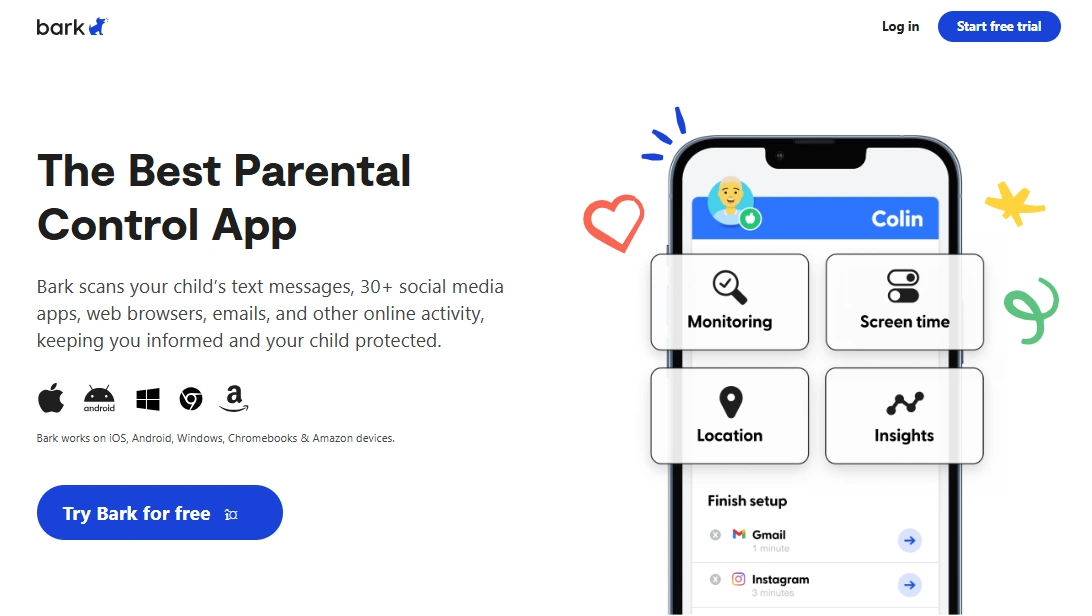
Description: Bark is a safety-first parental control platform. For under-13s, it shines when you want safer content + risk-based alerts and a predictable weekly review routine.
Product highlights:
- Safety-signal approach that supports calm parenting conversations
- Works best with weekly check-ins (not constant checking)
- Good fit when content safety is the main concern
What’s to like: Bark feels less like “watching everything” and more like setting guardrails. For many under-13 families, that’s exactly what reduces daily conflict.
What’s not to like: If you want ultra-simple “just block X and set a timer” controls with minimal learning curve, Parentaler can feel easier day one.
PROS:
- Great for content safety and early warning signals
- Encourages a healthier “review cadence” for parents
- Strong overall under-13 parenting fit
CONS:
- Best results require consistent routines (weekly review)
- Some features can vary by device/platform setup
Parentaler (under-13 fit)
Description: Parentaler is a practical parental control tool focused on straightforward, day-to-day control. For under-13 families, it’s a good choice when you want simple limits and routines without a steep learning curve.
Product highlights:
- Direct controls for schedules and basic monitoring
- Good “non-techy parent” fit
- Works well as a consistent rules-enforcement tool
What’s to like: If your main goal is “set limits, keep them consistent, stop fighting,” Parentaler gets you to a workable setup faster.
What’s not to like: If your main worry is unsafe content patterns and you want safety-style alerts, Bark often feels more purpose-built for that parenting goal.
PROS:
- Easy day-to-day use
- Strong fit for simple household boundaries
- Good starter choice for many under-13 families
CONS:
- Less “safety-signals-first” than Bark
- Families wanting more insight may upgrade later

Legal notes
Use parental controls only on a child’s device you own/manage and keep rules transparent and age-appropriate. Laws vary by location, and unauthorized monitoring can be illegal or violate platform policies.
If you want a clear, safe approach for setup and family rules, start here: legal phone tracking for parents.
FAQ
Is Bark or Parentaler better for kids under 13?
Bark is usually better if you want content safety and risk-based alerts. Parentaler is usually better if you want the simplest day-to-day controls and fast setup.
Which one is easier for non-techy parents?
Parentaler is typically easier to adopt quickly. Bark is still very workable, but it’s best when you use it as a weekly-review tool (not constant checking).
Do these apps work the same on iPhone and Android?
No. Android often allows deeper device controls. iPhone setups can be more permission-based and depend on correct configuration.
What rules reduce screen-time fights the fastest?
A fixed bedtime schedule plus a charging station outside bedrooms usually reduces fights more than tweaking app limits every day.
Should I tell my child about the parental control setup?
Yes. Under 13, transparent rules work best: what’s being restricted, why, and when you review it together.